
Choose the Roll for a Paso Robles Resident Lookup
Decide what the search must confirm. The answer picks the record. A parcel and deed trail establishes ownership roles. A court index shows a party, a case type, and docket events, while a vital record confirms an event or family link under its copy rules. A city license or a state entity filing documents a business affiliation, and a historical directory places a person at a dated address. The table keeps those uses apart.
| Record | What it can confirm | Where | Access boundary |
|---|---|---|---|
| Assessor parcel and GIS | Parcel, situs, legal description, selected assessment detail | SLO County Assessor and Parcel Viewer | Owner display and detail can be restricted |
| Recorded documents | Grantor, grantee, document type, date, number | County Clerk-Recorder | Index online; images by office or order |
| Superior Court index | Party, case number, type, status, docket events | SLO Superior Court | Sealed, juvenile, adoption, and confidential matters restricted |
| Vital indexes and copies | Birth, death, marriage, or divorce event and family links | County Clerk-Recorder and CDPH | Informational and authorized copy rules |
| License or business file | Public credential, business, agent, or practice affiliation | California DCA, bizfile, or Paso Robles Finance | Affiliation is not automatic residence |
| Historical directories | Dated person-to-address or occupation clue | Library and Society collections | Gaps and onsite access apply |
Start with the narrowest fact you know. One good detail changes everything. A full name paired with an old address, an APN, a spouse, an approximate year, a case number, or a business role narrows the field fast, and historic records call for searching both “Paso Robles” and “El Paso de Robles.”
Search One Name in Paso Robles Recorded Documents
The San Luis Obispo County recorder index is a strong name-to-address trail when the person appears as a grantor or grantee. Search it by name, document number, document type, map book and page, or through an advanced form. Enter the name LAST FIRST, no punctuation. A recording-date range tames a common surname, and a wildcard or a surname plus a first initial can catch a middle-name variation. The index is not a title guarantee. Results give party role, type, date, number, and map reference.
Coverage comes in tiers. The online index begins in 1923, while county recorded holdings reach back to 1850. Downloadable images start August 8, 2001. Later images can be ordered through the portal. A 1923 to 2001 hit may need an office or mail copy, and pre-1923 work belongs with the county books and counter.
The California Department of Consumer Affairs license search shows the professional-license fields used for a Paso Robles resident lookup.
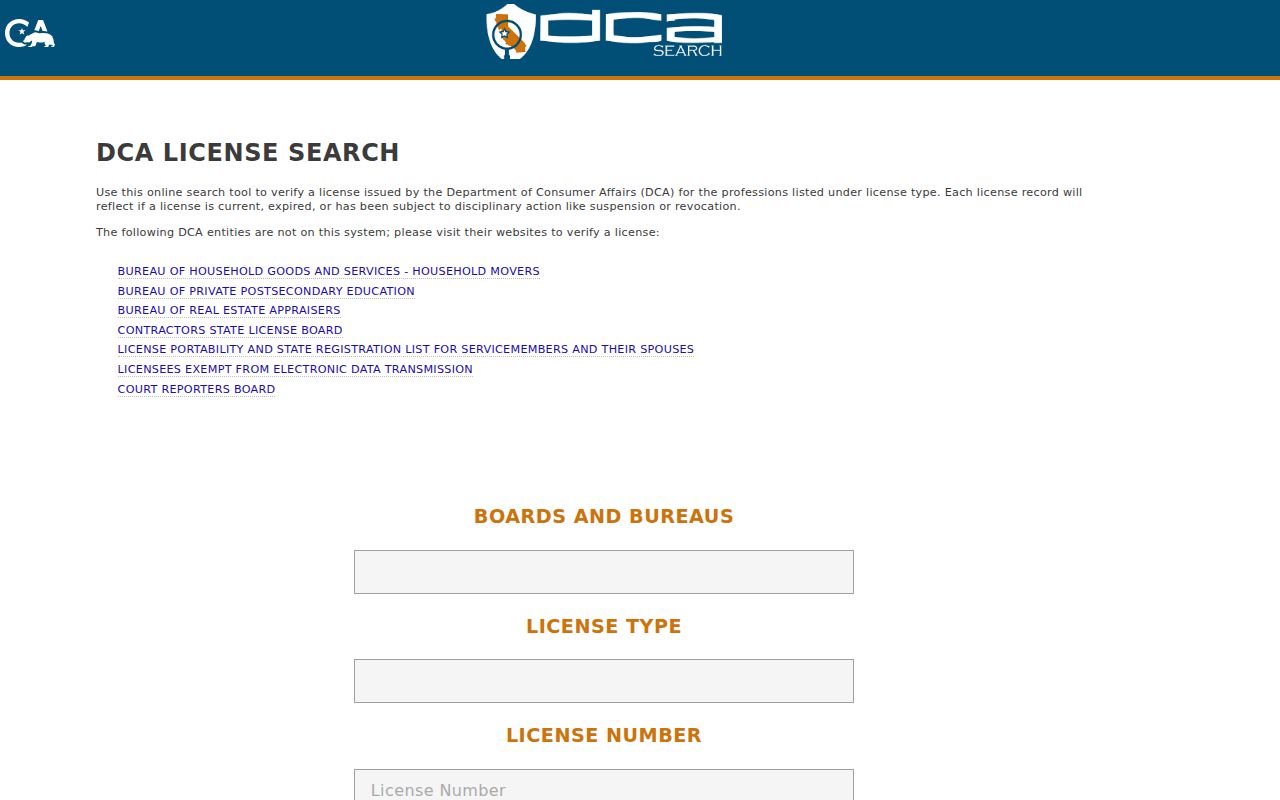
License and recorded-document results both need a role label before they are used to separate two people with the same name.
Read a Paso Robles Court Name Result Carefully
The Paso Robles Branch of the San Luis Obispo Superior Court serves the north county. It handles trial matters for that area. Remote access to public case records runs through re:SearchCA or eFileCalifornia registration. Prefer to work in person? Courthouse public computers support case-number lookup and public document review. The branch keeps reduced counter hours, so call 805-706-3600 before you drive over. Federal cases live in PACER, not the county trial portal.
A name match alone proves little. Verify the court and the case number. Check the case type, the filing date, and the party role. Confirm the docket event before drawing any conclusion. Juvenile, adoption, sealed, and confidential family-law material may be restricted or excluded entirely. Even a name in a civil index tells you nothing about the outcome.
| re:SearchCA control | Type | Use |
|---|---|---|
| Sign-in or registration | Credential gate | Needed for remote document access |
| Case number | Search text | Best discriminator when known |
| Party or person name | Search text | Compare variants against date and case type |
| Court or jurisdiction | Filter | Restrict to SLO Superior Court |
| Case or document selection | Result control | Open public material after a match |
Civil copies at the county cost $0.50 per page. Mail requests should include the case number, the parties, the documents you want, and a self-addressed stamped envelope. Research running past ten minutes carries a $15 fee under Government Code §70627(c), and certification is listed at $40 per case.
California Vital Records Have Two Copy Paths
Vital records do not work as a free public name browse. The San Luis Obispo County Clerk-Recorder keeps birth and death indexes you can inspect at the office, while copies come through county or state applications. California splits certified copies into two types under Health and Safety Code §§103526 to 103526.5. An informational copy aids family research but cannot establish identity. An authorized copy demands an eligible relationship, plus a sworn statement with a mail application.
County fees for 2026 are $34 for a birth record, $26 for a death record, and $19 for a marriage record. State pricing differs. CDPH lists $31 for birth, $26 for death, $19 for marriage, and $18 for a divorce certificate. Confidential marriage records go only to a party or someone with a qualifying court order. A CDPH divorce certificate covers 1962 through June 1984. It is not the decree.
Forms and eligibility details sit on the California Vital Records ordering page. Expect the application to ask for the event, names, place, date, relationship, copy type, signature, and payment. A certified copy closes a family link. A directory or index clue does not.
My Voter Status Is a Self-Check, Not a Resident Lookup
California's My Voter Status tool works only as a self-check. Enter first name, last name, date of birth, and a California license, ID, or the last four digits of a Social Security number when the record holds one. It returns your own registration, party or language setting, polling and election details, and mail or provisional ballot status. It does not return a Paso Robles residents list, a street roster, or the people tied to one address.
Election Code §2194 restricts voter-file release to candidates, qualifying committees, and election, scholarly, journalistic, political, or governmental uses. A permitted file may carry addresses and participation history. Identifiers, signatures, protected voters, and ballot choices never release. The Secretary of State application demands identity, residence, a permitted purpose, a security narrative, and a signature. A private person search must go through another lawful source.
The California My Voter Status form demonstrates why voter information is an authenticated self-check.
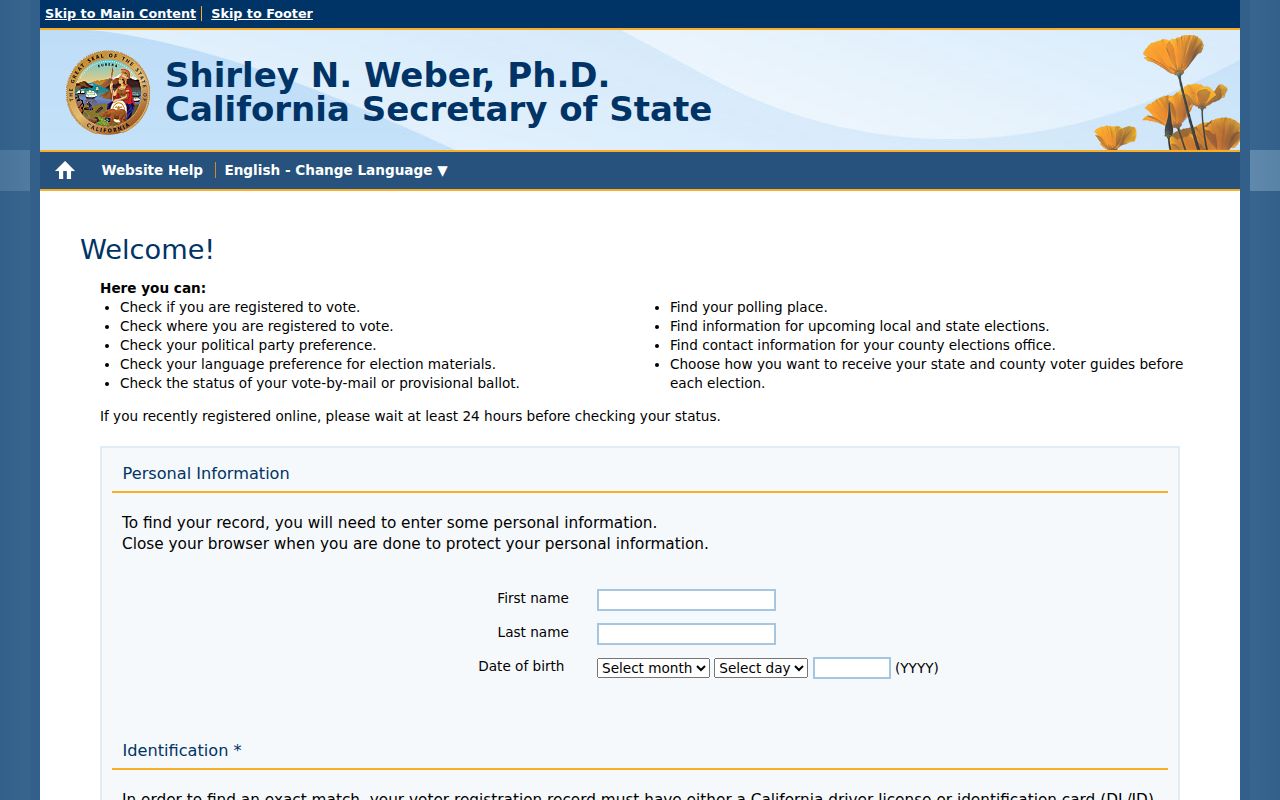
Authentication protects the voter record and keeps a one-person check separate from a public residents directory.
Separate Paso Robles License and Residence Addresses
A license record names a person. But its address field tells you where the license sits, not always where the person lives. Keep the label honest. The California Department of Consumer Affairs search runs on board, license type, license number, business name, first and last name, or registry number. Its advanced search adds city or county, status, discipline, and public documents. California bizfile takes an entity name or file number. It returns a street or mailing address, agent name and address, status, filing date, and filings.
Paso Robles Finance posts an active business-license roll. It lists license number, firm name and address, phone, state license number, start date, and business type. The Chamber directory adds current member affiliations, though it is not exhaustive. Tag any agent, practice, business, or mailing address as such in your notes. It can point you to the right person in the Paso Robles residents directory. But it does not prove a home address.
The DCA license search and California bizfile search are the official routes for those roles. They stand beside, not in place of, the assessor, recorder, and vital custodians.
Former Classmates and Heirs in Local Paso Robles Files
A resident lookup can serve a family-history purpose. The Virginia Peterson Research Library holds Paso Robles High School yearbooks, Bearcat newsletters, and class files covering 1931 through 1984. Start a former-classmate search with a year and a surname, then test any address clue against a newspaper, obituary, or city directory. These files can separate same-name people without publishing a roster of current Paso Robles households.
An heir search works in the other direction. Begin with a probate case or a recorded distribution document, use an obituary for a kinship lead, and confirm the relationship through the court or a deed record. The San Luis Obispo Superior Court and the Clerk-Recorder each handle a piece of that chain in San Luis Obispo County. A historical file supports the lead; a certified or recorded document supports the conclusion.
Prove a Paso Robles Match Across Two Records
The strongest verification links a name to a second stable fact. An APN, a date, a spouse, a court number, a license number, or a business filing carries more weight than a second copy of the same compilation. Use the record's own address label. Keep the source date beside it.
- Write the name in every form found: initials, former surname, hyphen, or reordered words.
- Choose the narrowest first source, such as the recorder index for a deed party or DCA for a license.
- Capture the date, role, address type, APN, case number, or filing number shown with the result.
- Check a different custodian, such as GIS, court, vital, newspaper, or local archive material.
- Stop when the second record conflicts and ask the custodian instead of merging the people.
- Docket
- The court's running record of filings, events, and case actions.
- Index versus image
- An index points to a record; an image or certified copy is the document to inspect.
- Certified copy
- A copy issued or certified by the custodian under its access and eligibility rules.
- Party role
- The relationship a name has to a deed, case, license, or filing.
What a Paso Robles Lookup Result Can Show
Capture the visible fields before deciding what a result means. A careful record inventory makes the source repeatable and exposes the limits of a name match in the Paso Robles residents directory.
| Recorded document | Indexed name, grantor or grantee role, document type, recording date, number, and map reference where relevant. |
|---|---|
| Court result | Party, case number, court, case type, status, docket event, and public document access. |
| Vital application | Copy type, event names, date and place, relationship, signature, eligibility statement, and payment. |
| License or entity | Name, number, status, filing or issue date, business or agent address, and discipline or filing links when public. |
A result can be accurate and still answer a different question. The word "address" alone is not enough. Record whether the field is situs, mailing, business, agent, or historical residence evidence.
California Limits on a One-Person Search
California shields certain address and identity fields even when a related public record exists. Safe at Home gives qualifying people a substitute mailing address and confidential voter registration. DMV data is restricted under 18 U.S.C. §§2721 to 2725. Voter rolls carry a permitted-purpose rule. Vital certificates use eligibility categories. Court systems withhold sealed, juvenile, adoption, and confidential material.
A lawful Paso Robles resident lookup can support family history, an heir question, or a classmate reunion. It can also back civic research, or a careful effort to verify a seller and avoid a scam. It cannot become a campaign to expose a protected person. It cannot be used to contact someone who never invited contact. If a source marks a record confidential, leave it with the custodian.
Privacy limit. A public record gives access to defined fields, not permission to stalk, harass, intimidate, or harm a person. Verify important facts with the office that holds them.
When the Paso Robles Resident Lookup Stops Online
When the portal ends, work a fallback chain. For a city record, ask the Paso Robles City Clerk for an existing, identifiable item. The request rides under the California Public Records Act. For a deed image or an old index hit, reach the San Luis Obispo County Clerk-Recorder by portal, mail, email, fax, counter, or office kiosk. For a vital event, use the county or CDPH application and the correct copy type. For a directory, tax roll, school file, or obituary, contact the Virginia Peterson Research Library.
State the person. Give the record type, the date range, the address or APN, and your delivery choice. CPRA can require a determination within ten days. Yet it never obliges staff to build a person dossier. Nor must it chase an open-ended question. A clear request lets the custodian say whether the record is disclosable, held elsewhere, or protected.
Note: When two official records conflict, preserve both citations and ask the custodian to explain the field rather than choosing the result that looks easiest.